Subterranean termite soil defense creates an invisible perimeter barrier around a home foundation, preventing worker termites from tunneling into sill plates, subflooring, and interior wall studs. In high-clay soils…
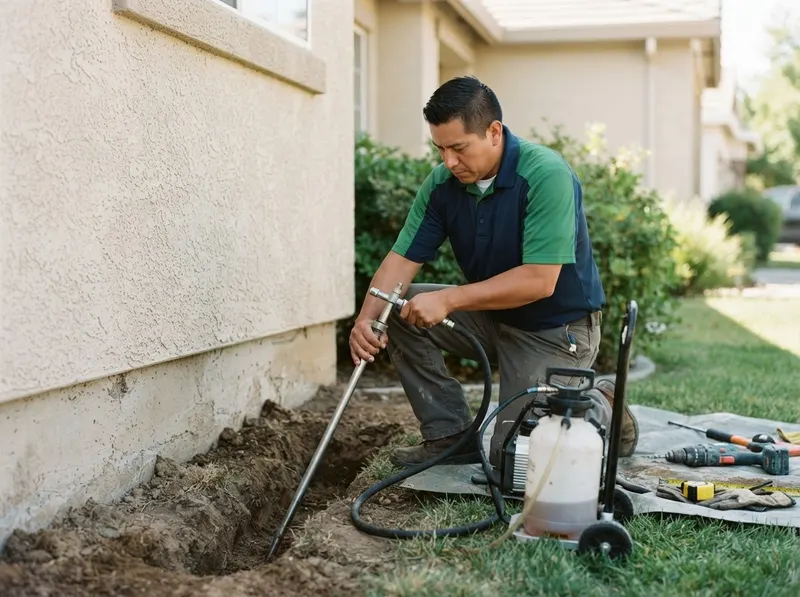
Subterranean termite soil defense creates an invisible perimeter barrier around a home foundation, preventing worker termites from tunneling into sill plates, subflooring, and interior wall studs. In high-clay soils across Sacramento County, native western subterranean termites (Reticulitermes hesperus) construct thin earth shelter tubes over concrete stem walls, seeking cellulose fiber. Instead of attempting surface-level repellent perimeter sprays that scatter foraging pests into alternate wall voids, modern preventative biosecurity relies on undetectable non-repellent termiticides. When subterranean workers transit through treated soil beneath landscaped borders, they carry active particles back to deep below-ground nesting chambers, causing progressive horizontal transfer and colony collapse according to university extension research. Trenching operations run 6 inches wide by 6 inches deep directly adjacent to exterior foundation walls, applying 4 finished gallons of diluted liquid formulation per 10 linear feet per foot of depth, strictly fulfilling specifications defined in EPA chemical standards.
Subterranean termite defense fits homes showing active subterranean mud tubes across exterior stem walls or sudden spring swarmer flights inside living rooms, while drywood termite infestations require targeted structural timber injection or thermal remediation instead of soil barriers. In post-tension slab developments throughout Madeira, Laguna West, and Lakeside, exterior expansion joints, concrete patio interfaces, and plumbing bath traps provide low-resistance entry corridors. Soil injection treats these vulnerabilities directly along footings. Concrete adjoining foundation walls, including porches and carports, requires micro-drilling 1/2-inch vertical holes spaced 12 inches apart through hardscape, followed by pressure injection to reach the subterranean soil plane. Homes in Sheldon on rural acreages with unpaved grade require trenching around detached outbuildings and wood-to-ground structural contacts, whereas older tract foundations in Fallbrook and Camden Park often feature raised crawlspaces requiring targeted stem-wall rodding and interior pier-block saturation.
Soil liquid defense applications deliver uninterrupted perimeter protection for 5 to 8 years, contrasting with localized wood baiting monitors that require ongoing quarterly consumption checks. Homeowners should evaluate trade-offs: while subterranean barrier installation requires minor turf displacement along foundation drip lines and precision concrete drill plugs beneath exterior doorways, it delivers immediate subterranean blockade without relying on unpredictable termite feeding cycles. Properties situated near the elevated riparian water tables of Laguna Creek, Elk Grove Regional Park, and the Stone Lakes National Wildlife Refuge experience damp clay silt layers that preserve sub-surface soil moisture, driving extensive subterranean termite activity late into dry autumn months. Liquid non-repellent treatments remain chemically bound to soil organic matter, resisting migration while defending interior structures against costly timber destruction.
1. Exterior structural evaluation pinpoints foundation mud leads, sill-plate moisture, and structural expansion gaps. 2. A continuous perimeter trench measuring 6 inches wide and 6 inches deep is excavated adjacent to foundation masonry. 3. Attached concrete patios and walkways undergo vertical 1/2-inch drilling spaced every 12 inches along footings. 4. Sub-surface rodding delivers liquid non-repellent emulsion calibrated to treat four gallons per ten linear feet into the excavated soil. 5. Trenches are backfilled with treated backfill earth, and all drill access holes are sealed with hydraulic cement to match concrete surfaces.
Every job gets a firm, written price after a free on-site visit.
For standards, safe disposal, and service guidance on pest control services in Elk Grove, CA, useful references include U.S. EPA, ENERGY STAR, U.S. Dept. of Energy, Consumer.gov, U.S. Census Bureau, and Google Maps. General consumer and small-business resources are available from USA.gov, Better Business Bureau, FTC Consumer Advice, U.S. Small Business Administration, and Ready.gov.
Tell us about your subterranean termite soil defense job in Elk Grove and we'll send a clear, written quote, usually the same day.
 QuickShield Exterminators